
Before Riverdance
The Early History of Irish Dance
Welcome to class — I’m really happy you’re here. Every so often I’ll send along something like this: a bit of background, history, or context that might add some depth to what we’re doing together in the studio. Think of these as totally optional reading for the curious-minded.
It’s important to me to share the history and context of my favorite art form, so you have a little more information about the magical journey you’re embarking on by learning Irish dance. A lot of what I’ll share in these articles comes from my personal experience, stories I’ve been told by teachers, musicians, and fellow dancers, or from my own research. Irish dance and music are really oral and aural histories — very little has been written down in this tradition. Much of what we know has been pieced together painstakingly by researchers who go out and talk to people, then passed along like a game of telephone. My ultimate goal is that people taking my classes are interested enough in what they’re learning to think critically about the history and context, and form their own opinions and ideas about it.
By all accounts, the Celtic dancing tradition started with the pre-Christian Celts and Druids who roamed both the island of Ireland and mainland Europe. Dancing was an integral part of life — used to celebrate and mourn, worship and understand the world. Circle dances (similar to some of the circle dances we still see in the more modern form of dance we do now) played a big part in Celtic life. There is evidence that dance was part of large Celtic gatherings, as communities came together to celebrate, trade, discuss politics, play sports, and swap stories. The Hill of Tara, the seat of the High King of Ireland 1,000 years ago, was the site of the Aonach (great festival), held yearly. Various invasions of Ireland after the twelfth century brought new dance traditions, different formations, new styles, and new musical instruments — like the bagpipes and harp.
In the 14th and 15th centuries, there is written evidence that dance was an important part of Celtic life, as visitors to the island made reference to dancing and music there — specifically dancing that emphasized rhythmic and percussive movement, practiced by men and women alike.
In the late 1600s, the Penal Laws enacted by England systematically pushed Catholic Celtic traditions out of public life. Catholic gatherings were outlawed, meaning the places where traditional dance and music would have happened were no longer allowed. The Irish language was stripped from politics and government, leaving the Irish-speaking majority unable to participate in governing themselves. Catholic people were not allowed to run schools, severely disadvantaging Irish-speaking children in government-run education.
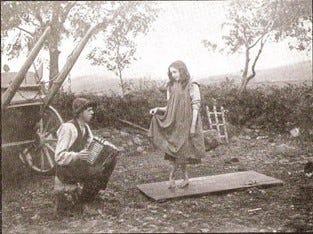
Despite all of this, Irish music and dance continued to develop in secret, and became a larger part of distinctly Irish culture — particularly for the growing Irish nationalist movement of the time. Children went to secret hedge schools, families taught tunes by lilting melodies with their mouths, and dancers learned rhythm in secret. The Penal Laws weren’t lifted until the late 1800s, meaning the Catholic majority in Ireland was denied basic rights — like voting, owning land, practicing their religion, and gathering in public — for nearly 200 years. And yet, Irish dance and music continued to flourish throughout. In the 1700s, the fiddle was introduced to Ireland from mainland Europe, propelling the tradition forward again. The distinctive hornpipe rhythm is also attributed to this period.
Traveling dance masters emerged in the late 1700s — highly regarded and honored guests in every village they visited — and Irish dance became more disciplined and codified. Dance masters were responsible for creating their own repertoire of specific steps. Dances were demonstrated on barrels, tabletops, or doors taken off their hinges. These early forms of step dancing were characterized by stationary, percussive movement, because dancers simply didn’t have room to travel side to side. Céilí (group) dances were created by dance masters as a way to involve everyone in the dancing, while the most skilled students were invited to perform on top of barrels or doors. Over time, rivalries between different dance masters and their territories developed — likely giving rise to the tradition of dance competitions that is still very much alive today.
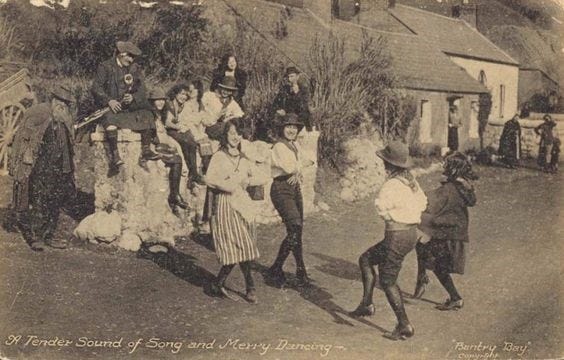
This only covers the early history of Irish dance, before the Great Famine of 1845, when 2 million Irish people emigrated from Ireland to various parts of the world. And that’s just where the story starts. We haven’t even gotten to the Famine, the diaspora, the Celtic Revival, or a certain 1994 Eurovision interval act that made the whole world want to pick up a pair of hard shoes. More to come.
Do you have specific questions you’d like me to answer in these articles? Pieces you’d like to discuss more? Things you heard about Irish dance that you think are worth a deep dive? Let me know! You know I can talk about this topic all day…
Additional Resources
If you want to do some of your own reading and research….
Thanks Carly! This is great information and fun to have context!